The Story of Twenty-Eight Pieces
The 28-piece historic collection at the İBB City Museum has been the most concrete witness to Eyüp toy-making since its first exhibition in 1939 — though it belongs to the İBB, not to our own museum.
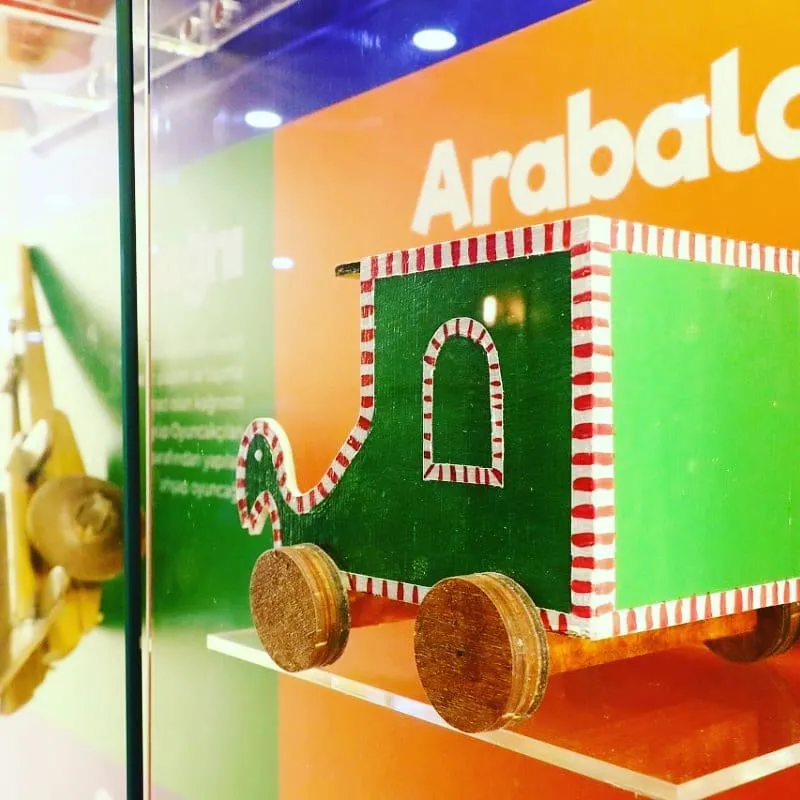
According to Fadime Geleş’s research, child and toy museums found in many countries, cities and towns around the world also support research that sheds light on the cultural history of the places they sit in. For İstanbul’s old toy trade, one collection serves that same purpose (Geleş, 2015).
The most concrete evidence of Eyüp toy-making’s history sits behind glass, but it isn’t our glass. The İstanbul Metropolitan Municipality (İBB) City Museum holds a documented collection of twenty-eight pieces, catalogued under the title “Eyüp Toys of the Past, From a Child’s World.” The toys were first exhibited in 1939 at the İnkılap Museum in Beyazıt; afterwards, this collection, thought to have passed into the İstanbul Municipality’s holdings by donation, became part of today’s İBB City Museum.
What the twenty-eight pieces hold
According to Füsun Kılıç’s 1993 inventory, the collection spans: four carts of different forms, one acrobat toy, one cradle and one rocking cradle, two rattling “çınçın” toys, one Ferris wheel, one chair, one wire cart, two clay jugs, two spinning tops, one “kaynana zırıltısı” rattle, one “devil’s minaret” toy, one handcart, four drums, one small drum, three tambourines, and one ball: twenty-eight pieces in total (Kılıç, 1993, p. 134). This tally doesn’t come from a single source: Tosun Yalçınkaya also carries the same 28-piece list, under the same Kılıç citation, in his own 2006 conference paper (Yalçınkaya, 2006, p. 293-294). The Cultural Research Foundation (KAV) has separately documented the same collection on its “Toy Research” page, which also carries the folk narrative for why the trade concentrated in Eyüp specifically.
The other end of the display case
The 28 pieces standing behind glass at the İBB today once passed through a different kind of display case. As Fadime Geleş records it, the shops of Oyuncakçı Çıkmazı had their production space at the back and a glass-fronted display window at the front, and sold both wholesale and retail (Geleş, 2015). The museum case can be seen as the last stop in that two-stage arrangement: a toy was first shown in its own shop’s window, and only decades later put on display a second time, in a museum case.
A reference list
In Yalçınkaya’s own conference paper, this 28-piece list appears directly before his own list of the sixteen toys the project made; the two lists sit side by side, letting the reader compare the historic tally with 2005 production.
When the project to revive Eyüp toy-making began in 2005, the first sixteen toy types it produced overlapped heavily with this 28-piece inventory: Ferris wheel, acrobat, cradle, devil’s minaret, wire cart, rattle, clay jug and handcart all appear on both lists under the same names; the inventory’s plain “drum” became a “handled drum” in the project’s list. That overlap suggests both lists trace the same documented toy tradition. But according to Tosun Yalçınkaya’s conference paper, the project’s own research base wasn’t this inventory: it was the Turkish History Foundation’s (Tarih Vakfı) earlier studies on Eyüp, specifically its research into the history of play and toys (Yalçınkaya, 2006, p. 291). As Fadime Geleş notes, the İBB’s twenty-eight pieces are valuable in their own right as objects that “guide researchers”: a reference point for those studying the tradition, not documentation showing that the project’s production choices were drawn directly from it (Geleş, 2015).
A question the academy also asks
The urge to compare the historic tally with today’s production isn’t ours alone. Ece Ebru Bayar’s 2021 master’s thesis takes up exactly “the similarities and differences between the toys recorded in the historical process and those produced here” (Bayar, 2021: thesis abstract). In other words, the relationship between the İBB’s twenty-eight pieces and what the workshop produces today sits on the same axis as the comparison this article draws, and has also been the subject of a peer-reviewed thesis.
Two places, one tradition
Those twenty-eight pieces still belong to the İBB City Museum’s collection, not to ours, but the types they represent live on in our museum and in our workshop. Thirty types of traditional Eyüp toy are displayed together at the first stop of our own museum too, a close number to the İBB’s, though the two collections remain entirely separate. The acrobat toy that leaves our hands today can be considered the descendant of the same mould as the one placed in a display case in Beyazıt in 1939. The historic collection preserves a frozen moment; what we make keeps the same tradition going as a living craft, passed hand to hand.
Sources
- Kılıç, Füsun. Toplumsal Tarihte Çocuk, 1993/94, p. 134.
- Yalçınkaya, Tosun (2006). “Eyüp Oyuncakçılığı ve Oyuncak Atölyesi,” Tarihi, Kültürü ve Sanatıyla X. Eyüpsultan Sempozyumu Tebliğleri, Eyüp Belediyesi, p. 290-295.
- Geleş, Fadime. “İstanbul Çocuk Oyuncakçıları,” Antik Çağ’dan XXI. Yüzyıla Büyük İstanbul Tarihi, Vol. 4, İSAM + İBB Kültür A.Ş., 2015. https://istanbultarihi.ist/138-istanbul-cocuk-oyuncakcilari
- Kültürel Araştırmalar Vakfı (KAV), “Oyuncak Araştırmaları / Eyüp Oyuncakları.” https://kultur.org.tr/oyuncak-arastirmalari-eyup-oyuncaklari-marmara-istanbul/
- Bayar, Ece Ebru (2021). “Eyüp oyuncakçılığı geleneği ve geleneksel Eyüp oyuncakçısı.” Master’s Thesis, Ankara Hacı Bayram Veli University, Department of Turkish Folklore, 150 p.