Why Were Children Brought to Eyüp?
Children about to be circumcised were first taken to the tomb of Eyüp Sultan, then allowed to choose a toy on the way home. Eyüp's toy trade grew largely out of this visiting custom.
It was widely believed that Eyüp Sultan loved children dearly. The most concrete result of that belief was a custom: children about to be circumcised were first brought to his tomb, and on the way home they were allowed to choose a toy. Tosun Yalçınkaya’s 2006 research confirms the custom directly: “Istanbul’s children were brought to Eyüp at circumcision time, and on the way back were allowed to choose the toy they wanted.” For a small child, this was both an ordeal and a reward: the nerves of the circumcision softened into a sweet memory, toy in hand. The tomb visit turned the child’s day from a daunting ordeal into something to look forward to.
A visit’s market
This simple custom shaped the very customer base of Eyüp’s toymakers. Toy shops were not scattered at random. They clustered right along the road to the tomb, so a family walking home from their visit passed the toymakers whether they meant to or not. Toys made in Eyüp travelled from there to aktar shops in every quarter of Istanbul and out with street vendors, reaching many corners of Anatolia. That is why, as the saying went, mention a toy and Eyüp came to mind first. Yalçınkaya’s paper sums up that distribution in a single line:
“Toys were distributed from Eyüp to many corners of Anatolia.”
A family from Istanbul who came in person for the circumcision visit carried the toy home in hand; a child at the far end of Anatolia most likely got the same toy through an aktar shop or a street vendor’s basket. The visit brought one family to Eyüp, but it was the visit’s fame that carried the market to a whole country.
The “why Eyüp?” account gathered in the field by the Cultural Research Foundation (KAV) points to the same thing: the custom grew as a natural extension of a religious visit, and the toymaking trade was built on top of that extension. The 28 pieces the Foundation also documented, now held in the Istanbul Metropolitan Municipality’s collection, are still the concrete trace of that market today. Evliya Çelebi’s 17th-century record of a 100-shop production network rounds out that picture: the early testimony we tell in our post The Eyüp Toymakers Through Evliya Çelebi’s Eyes points to the same market being fed by the circumcision visit across centuries.
Why Eyüp, specifically?
Why did this visiting custom grow into such a market in Eyüp, of all places, and not somewhere else? Academic research has asked the same question. Ece Ebru Bayar’s 2021 master’s thesis and her 2026 published article examine, within a place-culture (mekân-kültür) frame, the historical, social and economic reasons toy-making emerged in Eyüp; her fieldwork, carried out through participant observation and interviews, documents how the tradition survives today as a “revitalised” piece of heritage. That local specificity is now formalised in the Ministry of Culture and Tourism’s National Inventory of Intangible Cultural Heritage too: the tradition is registered as its own sub-element, tied directly to this district of Istanbul, under the name “Eyüp Toy-Making” (code 1.008.01/34). So the answer to “why Eyüp?” can be found not only in folk narrative, but in peer-reviewed research and the official inventory as well.
The festive world of circumcision
A circumcision was never just a ceremony; it was a whole festival, with music, performance and play gathered around the child. UNESCO’s 2009 inscription of Karagöz on the Representative List of the Intangible Cultural Heritage confirms this same festive world: the shadow play, its figures cut from camel or ox hide, was performed on Ramadan nights and at circumcision feasts alike. The tradition we pass on today in our Hacıvat & Karagöz workshop shared that same festive calendar with Eyüp’s toymakers.
It isn’t hard to imagine two crafts sharing that same festive calendar: by day, a family arriving at the tomb might let their child choose a toy; by night, the circumcision feast’s entertainment could bring Karagöz and Hacivat to life on a Hayalî’s screen. One was a gift held in the hand, the other a show watched with the eyes, but both belonged to the same festive calendar. Both traditions still live under the same roof today: toys are painted, and shadow figures are cut out and played together.
The same road, today
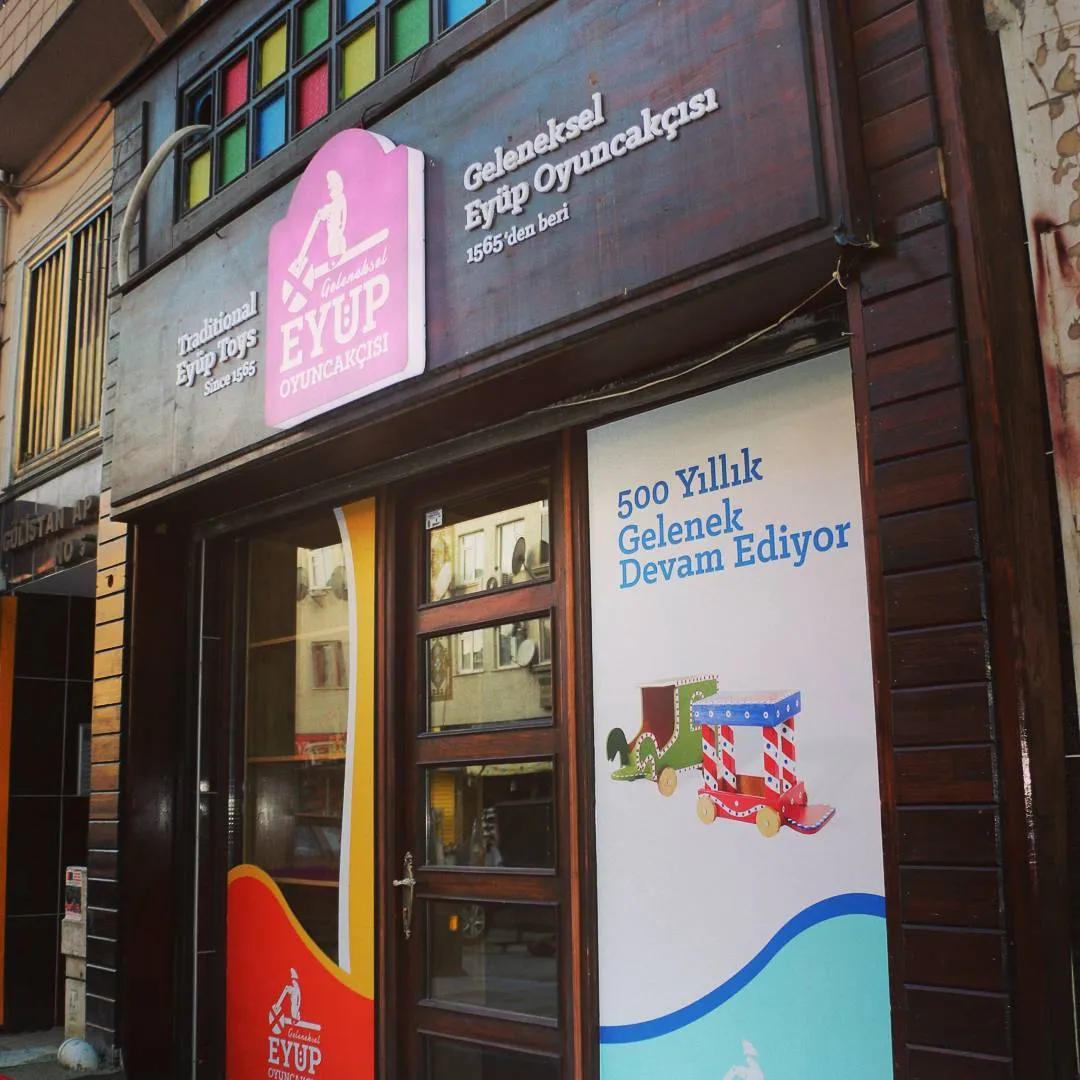
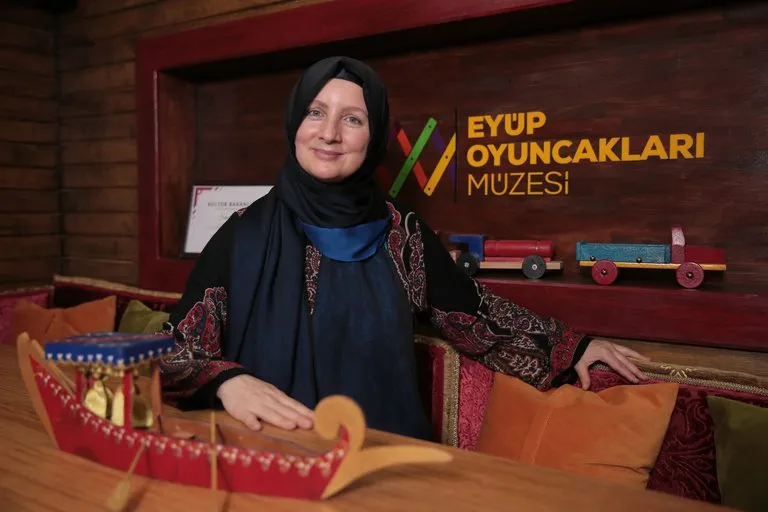
Families with children still come to Eyüp Sultan today; the tomb visit continues, and the toymaker still stands along the same road. Bayar’s research studied today’s museum-workshop through participant observation and interviews. The toys we offer children in our workshop carry on the very models once placed in their hands at the end of that same visit. In our museum you can see pieces from that era and read more closely how the tradition grew in the shadow of a visit.
Sources
- Kültürel Araştırmalar Vakfı (KAV), “Oyuncak Araştırmaları / Eyüp Oyuncakları,” https://kultur.org.tr/oyuncak-arastirmalari-eyup-oyuncaklari-marmara-istanbul/.
- Yalçınkaya, Tosun (2006). “Eyüp Oyuncakçılığı ve Oyuncak Atölyesi,” Tarihi, Kültürü ve Sanatıyla X. Eyüpsultan Sempozyumu Tebliğleri, Eyüp Belediyesi, s. 290-295.
- UNESCO Intangible Cultural Heritage Lists, “Karagöz,” Representative List (Decision 4.COM 13.73), 2009, https://ich.unesco.org/en/RL/karagoz-00180.
- Bayar Gündoğdu, Ece Ebru (2026). “Kültürel Mirasın Sürdürülmesi ve Güncellenmesi Bağlamında ‘Geleneksel Eyüp Oyuncakçısı’,” Culture and Civilization, no. 10, pp. 10-20. DOI: 10.62425/culture.1865799
- Bayar, Ece Ebru (2021). “Eyüp oyuncakçılığı geleneği ve geleneksel Eyüp oyuncakçısı.” Master’s Thesis, Ankara Hacı Bayram Veli University, Department of Turkish Folklore.
- SOKÜM Türkiye Ulusal Envanteri (Turkey’s National Inventory of Intangible Cultural Heritage), Ministry of Culture and Tourism, Directorate General for Living Heritage, “Eyüp Toy-Making,” code 1.008.01/34.