The Eyüp Toymakers Through Evliya Çelebi's Eyes
The earliest known written record of Eyüp toy-making is found in the Seyahatnâme, the 17th-century travelogue of the famed traveller Evliya Çelebi — 100 shops, 105 masters, and a toymaker scene from a guild procession.
The earliest written record we can trace of Eyüp toy-making comes from the Seyahatnâme, the travelogue the famed traveller Evliya Çelebi wrote in the 17th century. Counting the city’s guilds one by one, Evliya Çelebi does not skip the toymakers of Eyüp: 100 shops, 105 masters. Large enough a craft to form a guild of its own. It is the first solid anchor of the story we tell today, in our workshop and in our museum.
Toymakers in the guild procession
In the great guild procession Evliya Çelebi describes, the toymakers marched too, carrying reed pipes, whirligigs, tambourines, small drums and fiddles. He records the liveliest moment of the parade in his own words:
“Among them, portly gentlemen got up in women’s caps clung to the parents passing by in the procession — some weeping, crying ‘oh nanny! I want this toy — or I don’t want it!’ — as they went along striking their little axes and drums. They are odd guild mimics.”
A catalogue of toys from another age
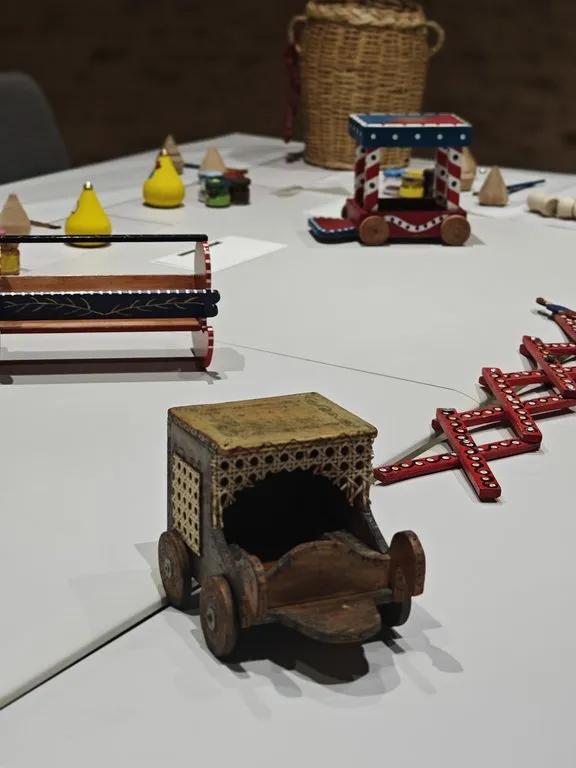
On the stalls Evliya Çelebi saw stood small mirrored jugs, ewers and cups; tin-belled tambourines and drums about a hand’s width across, tiny carts with wheels the size of an old mecidiye coin (roughly 2 centimetres), tiny cradles and rocking-cradles, whip- or cord-spun tops, reed whistles, mortars, roly-poly dolls, hand-clappers, miniature butter-churns, and red-fleeced toy sheep and lambs, lined up row on row. Painted mirrors, two- and three-balconied mosqueless minarets, wooden swords, reed rifles, whistling whirligigs, grasshoppers, clay jugs filled with water to whistle when blown, mirrored cradles, string-pulled arrows, inflatable bagpipes, Ferris wheels, and painted balloons made from bumbar (animal gut) filled the same stalls. Add red-and-green painted rowboats and imperial caïques to the list, and what emerges is a catalogue proving the 17th-century toymaker had already made the ancestor of nearly every toy our workshop produces today.
Faced with a catalogue this rich in colour and ornament, one question comes to mind: were toy-makers barred from carving human or animal figures on religious grounds? Yalçınkaya’s paper directly rejects that common belief: the claim that figures went unmade for religious reasons does not hold up. The list above points to the same conclusion — red-fleeced sheep and lambs, mirrored rowboats, roly-poly dolls: all of them figured, all of them brightly coloured.
A second witness: Ali Rıza Bey
Evliya Çelebi’s list does not stand alone. According to Yalçınkaya, another observer of the era, Balıkhane Nazırı (Superintendent of Fisheries) Ali Rıza Bey, set down his own list of the period’s children’s toys in his book: red-fleeced sheep and lambs, hollowed wooden rowboats painted green and red, imperial caïques, painted mirrors, whirligigs, two- and three-balconied mosqueless minarets, wooden swords, reed rifles, drums, tambourines, whistling whirligigs, grasshoppers, roly-poly dolls, clay jugs and cups. The list overlaps almost entirely with Evliya Çelebi’s. Two separate witnesses recording the same toys in the same century points to this catalogue being no traveller’s exaggeration, but a real, working range of production for the era.
The toy as performance
These lines tell us two things. First, Eyüp toy-making was already an organised craft by the 17th century, with its own shops and its own masters, registered in the city’s guild order. Second (and perhaps more telling), the toy had been a matter of spectacle from the very start. Fake nannies carried through the crowd, grown men dressed as women or children, a weeping “gentleman” demanding a toy… the troupe Evliya Çelebi calls “odd guild mimics” turned the toy into street theatre, made onlookers smile, and sent children chasing after a toy of their own, not unlike a child today spinning a string top.
Numbers and a distribution network: Koçu’s confirmation
The figure Evliya Çelebi gave, 100 shops and 105 masters, turns up again three centuries later. Reşad Ekrem Koçu confirms these numbers in the “Eyyubsultan Oyuncakları” entry of his İstanbul Ansiklopedisi, and adds that the toys were never confined to Eyüp’s own shops. From there they travelled to aktar shops in every quarter of the city and out with street vendors, reaching many corners of Anatolia. The 100 shops Evliya Çelebi saw were, in other words, only the starting point of a much larger network stretching across the whole city.
What remains today
The 100 shops Evliya Çelebi counted are gone, but the tradition he recorded still lives on in our museum. Same toy types, same materials and craft, same habit of telling a story: one line running from the 17th century to today. For the wider milestones of the tradition, see our post A History of Eyüp Toy-Making.
Sources
- Evliya Çelebi, Seyahatnâme, C. 2 (akt. Zuhuri Danışman Yayınevi, 1969, s. 302-303).
- Yalçınkaya, Tosun (2006). “Eyüp Oyuncakçılığı ve Oyuncak Atölyesi,” Tarihi, Kültürü ve Sanatıyla X. Eyüpsultan Sempozyumu Tebliğleri, Eyüp Belediyesi, s. 290-295.
- Koçu, Reşad Ekrem (yay.), “Eyyubsultan Oyuncakları,” İstanbul Ansiklopedisi, C. 10 (ERI-FIR), 1972, s. 5461-5462.