Karagöz and Ebru: Our Neighbours on the UNESCO List
Karagöz and ebru, the two neighbouring crafts practised in our workshops, both hold a place on UNESCO's Representative List; Eyüp toy-making is the third neighbour, with a national record of its own.
Two of the crafts we teach children in our workshops carry their own UNESCO credentials. The Representative List is a mechanism run under UNESCO’s 2003 Convention, meant to make cultural diversity visible through intangible heritage. Karagöz shadow theatre was inscribed on UNESCO’s Representative List of the Intangible Cultural Heritage of Humanity in 2009 (Decision 4.COM 13.73). The art of ebru, or paper marbling, followed onto the same list in 2014. Both sit in our workshop programme as neighbouring crafts. A third neighbour is closer still: Eyüp toy-making itself.
Karagöz: a theatre cut from hide
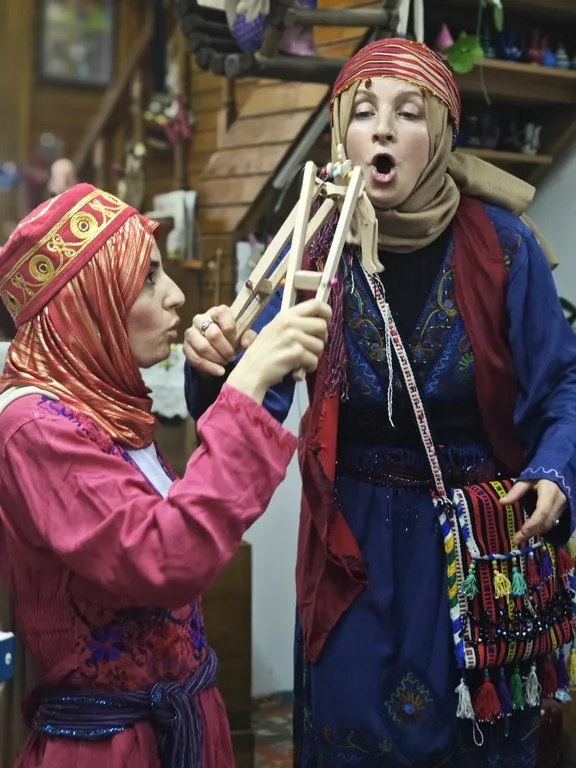
Per UNESCO’s inscription, Karagöz shadow theatre is traditionally performed with figures (“tasvir”) cut and painted from camel or ox hide, brought to life by light from behind a screen. A small troupe (a Hayalî master and his apprentices) carries the show; it was traditionally staged on Ramadan nights and at circumcision feasts, a festive calendar that overlaps with the tradition of bringing children to Eyüp for their circumcision visit. In our Hacıvat & Karagöz workshop, children sand, assemble and paint wooden shadow-play figures alongside us; the original hide figures are displayed in our museum.
UNESCO’s inscription also describes how the play itself is built: it opens with an introductory figure that sets the scene and themes, then vanishes to the shrill sound of a whistle, giving way to the main performance. Alongside Karagöz and Hacivat, secondary characters take the stage too: the Kantocu, described as a cabaret chanteuse, and the Hokkabaz, an illusionist-acrobat; the stories themselves are woven from puns and imitations of regional accents. The Hayalî’s apprentices learn the craft two ways: by helping create the tasvirs, and by accompanying the action with music. The record notes the play was traditionally staged in coffeehouses, gardens and public squares, especially during Ramazan, and today is more often found in performance halls, schools and malls in larger cities. UNESCO also credits the tradition with strengthening a sense of cultural identity while bringing people together through entertainment. Our own programme answers to that same breadth of characters: the workshop runs a different figure each week, Karagöz, Hacivat, Zenne, Beberuhi, Keloğlan or Nasreddin Hoca. An original screen once used in performances is also displayed in our museum, the very kind of screen behind which the play is staged.
Ebru: paint on water
Ebru is the technique of laying natural pigments on a thickened water surface, shaping a pattern, and transferring it onto paper or another surface; UNESCO’s 2014 listing (Decision 9.COM 10.44) records the technique as the “Turkish art of marbling.”
UNESCO’s inscription also lists the motifs ebru produces: flowers, foliage, ornamentation, latticework, mosques and moons. These patterns traditionally decorate book covers in the art of bookbinding. The colouring process is described too: the artist extracts colours from natural pigments using natural methods, mixes them with a few drops of ox-gall (a natural acid), then sprinkles and brushes them onto the prepared thickened liquid.
How the craft is passed on is recorded as well: knowledge and skill move from master to apprentice orally and through hands-on practice, and reaching basic proficiency takes at least two years. UNESCO notes the art is practised without barrier of age, gender or ethnicity, and plays a role in women’s empowerment and in strengthening community relationships. The same logic of transmission runs through our own workshop; here, the master-apprentice relationship is replaced by direct hands-on work between instructor and child.
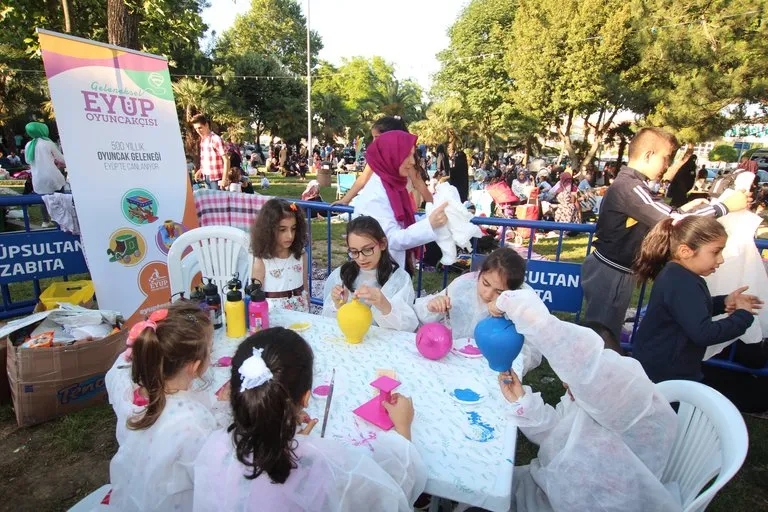
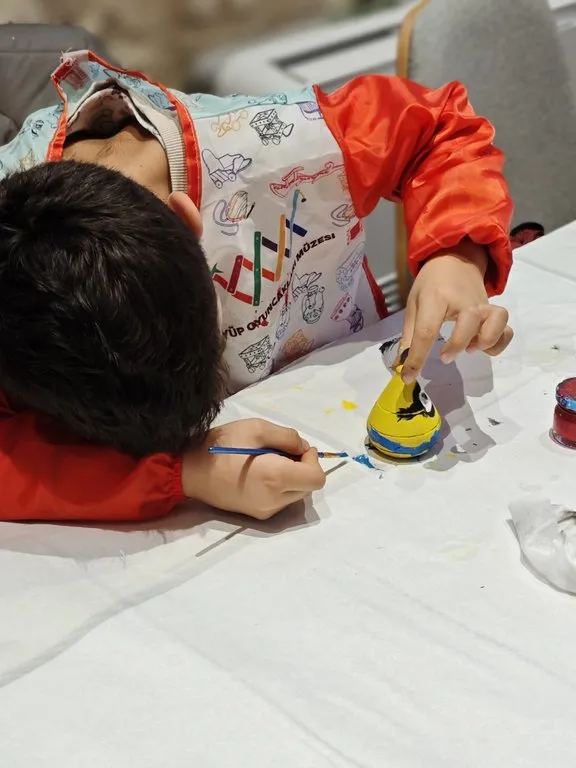
In our marbling workshop, the same technique is applied to the leather skin of a drum, with or without a handle; while the drum’s skin is marbled, its sides are painted in acrylics to a story, and the finished toy is wrapped and handed to its maker: a single toy where the two crafts meet.
A third neighbour: Eyüp toy-making
While Karagöz and ebru sit on UNESCO’s international list, Eyüp toy-making has its own national record: it is registered in Türkiye’s Intangible Cultural Heritage National Inventory (SOKÜM), kept by the Ministry of Culture and Tourism’s Directorate General of Living Heritage, as “Eyüp Oyuncakları Yapımcılığı,” code 1.008.01/34. That entry sits as a sub-element under the “Traditional Toys and Toy-Making” element within the inventory’s “Traditional Children’s Games and Toys” domain, listed under sequence number 570 with an İstanbul provenance. Three crafts, three separate registrations, all under one workshop’s roof, handed on to children with the same patience. Karagöz’s record is filed under 4.COM 13.73, ebru’s under 9.COM 10.44, Eyüp toy-making’s under 1.008.01/34; decisions from three separate bodies, meeting inside one workshop’s programme. A child arriving at the workshop doesn’t, of course, know any of these three records by heart; all they know is that the shadow figure or the marbled drum in their hands is telling them a story.
Sources
- UNESCO Intangible Cultural Heritage Lists, “Karagöz,” Representative List (Decision 4.COM 13.73), 2009. https://ich.unesco.org/en/RL/karagoz-00180
- UNESCO Intangible Cultural Heritage Lists, “Ebru, Turkish Art of Marbling,” Representative List (Decision 9.COM 10.44), 2014. https://ich.unesco.org/en/RL/ebru-turkish-art-of-marbling-00644
- SOKÜM National Inventory of Türkiye, Ministry of Culture and Tourism Directorate General of Living Heritage, “Eyüp Oyuncakları Yapımcılığı,” code 1.008.01/34.