The Academy Wrote About Our Workshop
A 150-page master's thesis and a peer-reviewed journal article have studied Eyüp toy-making and our museum-workshop as a case of updating and revitalizing a tradition.
A thesis, an article
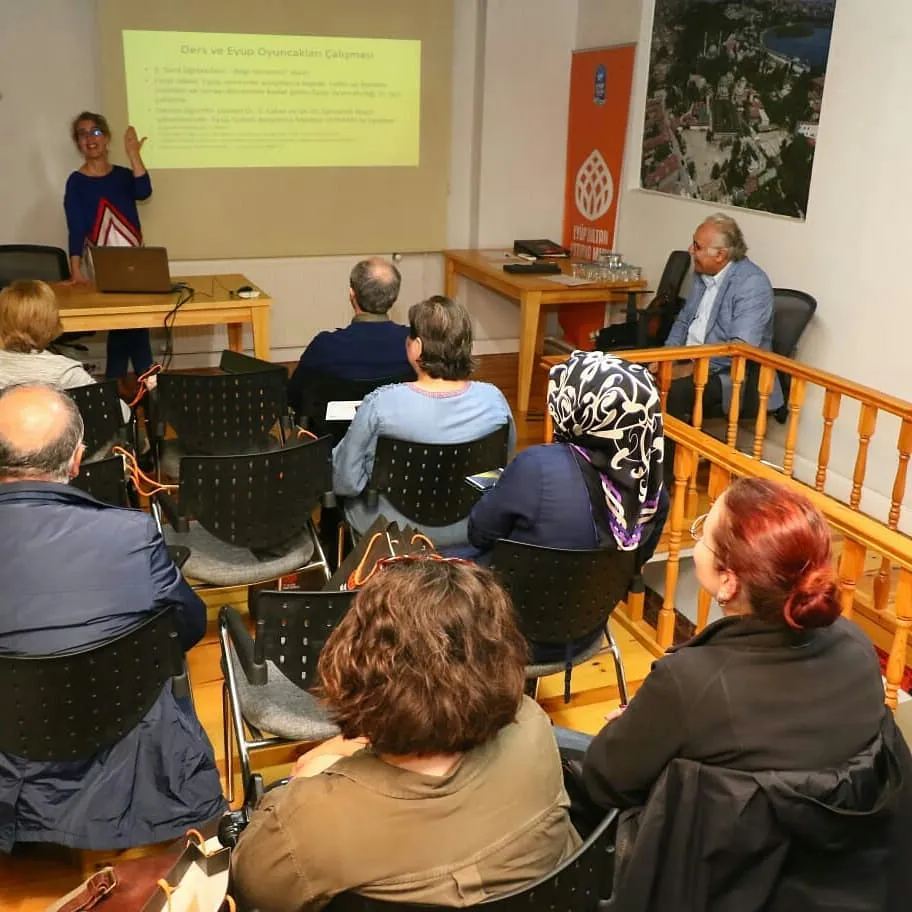
Eyüp toy-making has drawn academic attention in recent years. In 2021, Ece Ebru Bayar completed a 150-page master’s thesis at Ankara Hacı Bayram Veli University’s Department of Turkish Folklore, titled “Eyüp oyuncakçılığı geleneği ve geleneksel Eyüp oyuncakçısı” (“The Tradition of Eyüp Toy-Making and the Traditional Eyüp Toymaker”). The same researcher, publishing under the surname Bayar Gündoğdu, followed it in 2026 with a peer-reviewed article in Culture and Civilization: “Kültürel Mirasın Sürdürülmesi ve Güncellenmesi Bağlamında ‘Geleneksel Eyüp Oyuncakçısı’” (“The Traditional Eyüp Toymaker in the Context of Sustaining and Updating Cultural Heritage”). The article was supported under project no. 01/2020-2021 of Hacı Bayram Veli University’s Scientific Research Projects (BAP) unit, and was published on 25 April 2026. Both works look at Eyüp toy-making as a tradition, and at our museum-workshop specifically: one at the scale of a full thesis, the other within the pages of a peer-reviewed journal.
What the researchers examined
Bayar carried out her research through participant observation and interviews, visiting our workshop and following the work first-hand, talking with the masters and with visitors. Participant observation is a method often used in folklore research: rather than watching from the outside, the researcher takes part in the everyday running of the setting itself while gathering data. In her framing, our workshop is a case worth studying within the “updating,” or revitalisation, of tradition: a concrete instance of how an interrupted craft is carried forward by a new generation.
The thesis’s several axes
Bayar’s thesis approaches the subject from more than one angle. The thesis’s own abstract lists, among its topics: how the toys have found a place in the collective subconscious and how they continue to live on in the memory of older generations; how the experience made possible within the museum-workshop shapes the transmission of culture through story (which overlaps with the “heritage passed on through story” theme below); the similarities and differences between the toys recorded in historical sources and what is produced in the workshop today; and the connection between the toys and the concept of folklorism (Bayar, 2021: thesis abstract). A craft here isn’t studied only through the question of how it’s made, but through how it has found a place in a community’s memory, and through the relationship its present-day production holds with the historical record.
A heritage passed on through story
One of the thesis’s central arguments is that cultural transmission here happens through storytelling. According to Bayar, the museum-workshop hands the tradition on not by presenting toys as bare objects, but by letting children experience them together with the stories behind them: a living practice within a craft recorded as intangible cultural heritage.
The “authentic” question
Whether a revived tradition can be called “authentic” is a question often debated in heritage studies. In folklore studies, the term “fakelore” describes cultural elements that look traditional but were in fact invented later, or stripped from their original context; “revitalization” refers to an interrupted practice being carried forward by a community’s own initiative, adapted to present-day conditions. When an interrupted craft starts up again, is it still the same tradition, or something new modelled on it — this question sits squarely between those two concepts. In heritage literature, this debate comes up not only for Eyüp toys but for many crafts and traditions interrupted and later restarted; “authenticity” is often less of a clean line than it seems.
In the thesis’s own words, the toys produced in the workshop are placed “folklor ile fakelore arasında hangi noktada durduğu” (“at what point between folklore and fakelore the toys produced here stand”), and whether this amounts to an invented tradition is questioned (Bayar, 2021: thesis abstract). Bayar’s 2026 article takes up the workshop through a different pair of terms: whether the toys made here should be read as fakelore, or as falling under revitalization, a heritage-preservation model in its own right. In her framing, keeping an interrupted tradition alive under today’s conditions can itself count as a form of “updating” it; neither the thesis nor the article ties the question to a closed conclusion, both keep asking rather than answering it.
Not our words, theirs
We didn’t write these lines. Researchers did; we simply keep doing the work in our workshop. Still, having an academic’s effort go into recording the toys and the stories we tell in our museum means a great deal to us: a tradition that began in a conference paper now finds its place in a thesis, and in a peer-reviewed article too. For a craft to find a place in the academic literature means it is no longer only a shop’s concern, but a discipline’s — a development that sits outside our daily work, yet adds something to it.
Sources
- Bayar Gündoğdu, Ece Ebru (2026). “Kültürel Mirasın Sürdürülmesi ve Güncellenmesi Bağlamında ‘Geleneksel Eyüp Oyuncakçısı’,” Culture and Civilization, sayı 10, s. 10-20. DOI: 10.62425/culture.1865799.
- Bayar, Ece Ebru (2021). “Eyüp oyuncakçılığı geleneği ve geleneksel Eyüp oyuncakçısı.” Yüksek Lisans Tezi, Ankara Hacı Bayram Veli Üniversitesi, Türk Halk Bilimi Anabilim Dalı, 150 s.