From the Golden Horn's Red Clay to the Whistling Jug
Eyüp toy-making brings wood to mind first; but one branch of the tradition runs straight to the red clay on the banks of the Golden Horn, and from there to fired clay jugs and whistling pinwheels.
Eyüp toy-making brings wooden carts and painted dolls to mind first; but one branch of the tradition runs to clay, straight to the red mud on the banks of the Golden Horn (Haliç). On Toymakers’ Lane, along İskele Caddesi toward Eyüp Sultan’s tomb, two crafts were carried on side by side in the same facing rows of shops. In the same market, among the same tradesmen, a completely different craft was carried on beside the hands carving wood: one that sought its shape in clay.
From clay to jug
According to Fadime Geleş’s research, Eyüp’s jugs were made from the Golden Horn’s red clay. Tosun Yalçınkaya describes the process in slightly more technical terms in his conference paper: toys made of clay were produced by working the familiar red earth into a form and firing it in a kiln. The jug, in other words, depended on a production chain entirely different from wooden toys (digging the clay, shaping it, drying it, firing it), a separate craft branch that demanded its own mastery alongside woodcarving (Yalçınkaya, p. 294).
The clay jug on the market’s own list
The clay jug’s presence is not limited to the records of Evliya Çelebi and Ali Rıza Bey; it also appears on Toymakers’ Lane’s own product list. According to Geleş: “Among the toys mentioned, those whose production continued up to the start of the 20th century included hoops, carts, ferris wheels, earthenware jugs, whistles, tambourines, small drums, pinwheels, balls, spinning tops, wire cabinets, chairs, mirrored cradles, clappers, kaynana zırıltısı, handled drums, roly-poly toys, mortars, butter churns, acrobat toys, grasshopper toys, sheep-and-lamb figures, Karagöz-Hacivat figures, and similar items.” Among the list’s mostly wooden entries, the clay jug carried the trace of a different production chain; its being named alongside sound-making toys like whistles and small drums suggests clay was not separate from the market’s repertoire of sound toys either.
A whistle in the historical list
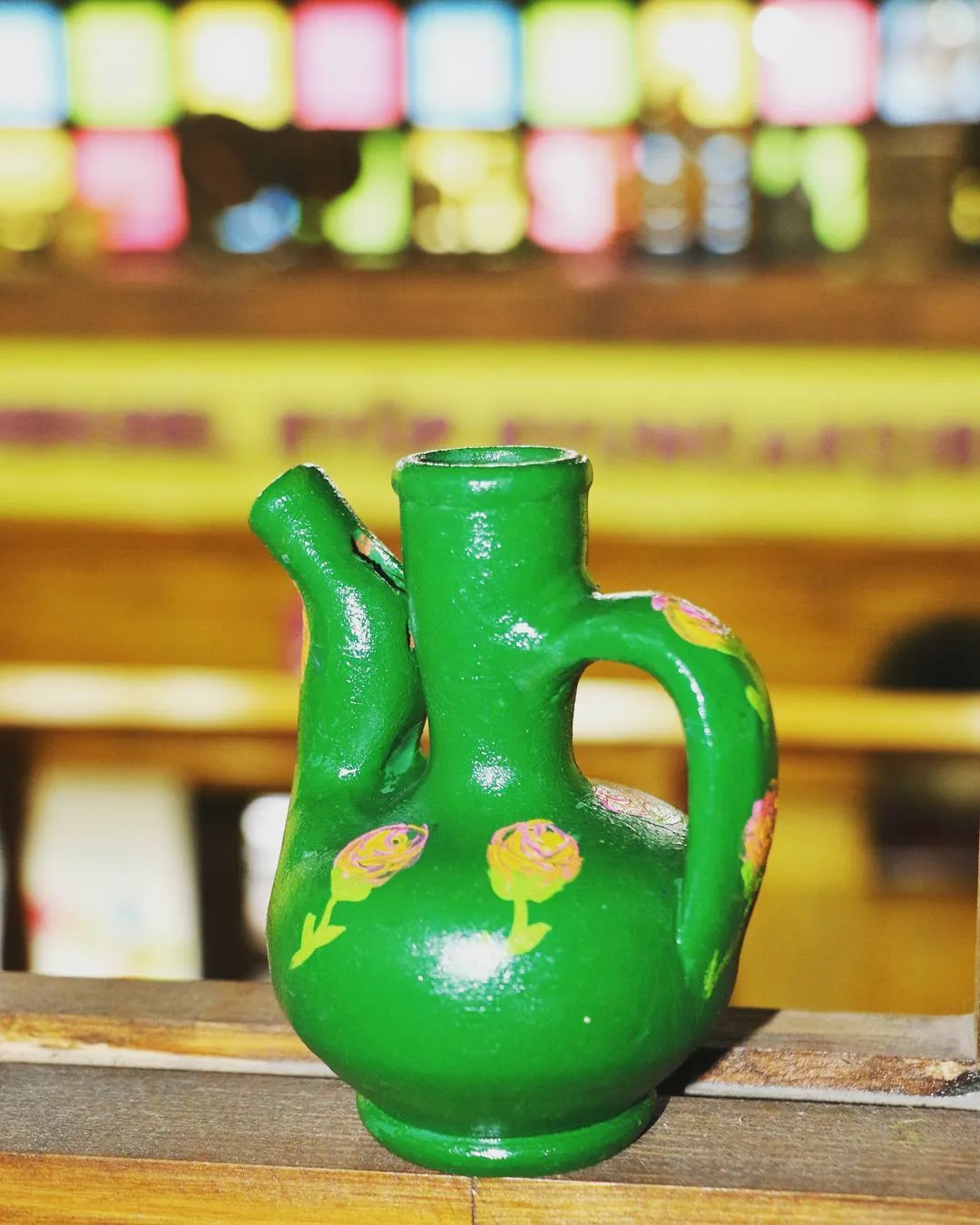
The historical toy list, drawn from the records of Evliya Çelebi and Ali Rıza Bey, names these jugs explicitly: “earthenware jugs filled with water and made to whistle” (Yalçınkaya, p. 292). Our whistling jug today is close to a literal rendering of that line: a jug that, filled with water and blown into, lets out a whistling sound.
Clay from the Şengöz family’s own hands
The clay craft, too, passed through the tradition’s last masters. In a 2004 interview with Hülya Yalçın, Halit Şengöz named clay alongside wood: “We didn’t only make wooden toys; we also made whistling clay jugs, mirrored jugs and darbukas” (Hülya Yalçın, 2004; qtd. in Geleş, 2015). We carried this interview in full in our post on the Şengöz family’s century of work; the mirrored jug named here is a type with no direct equivalent in our production today, but one we know passed through the Şengöz family’s own hands.
The colour of the paint
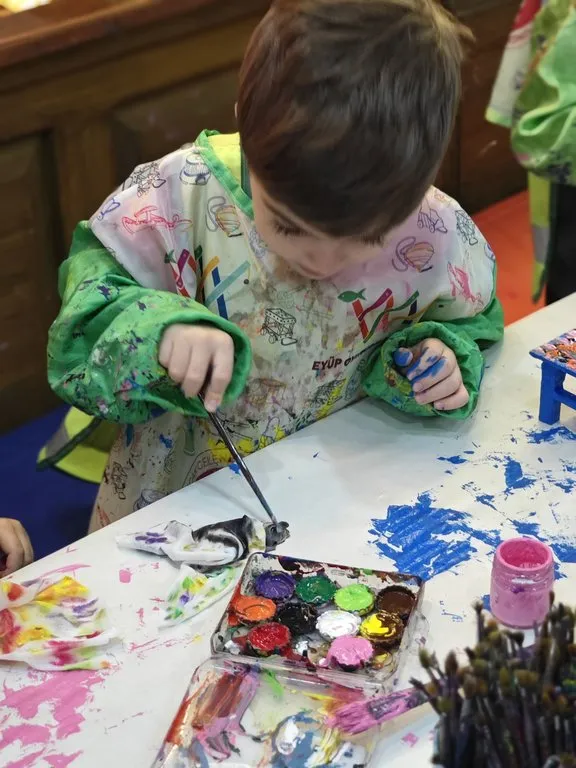
Clay jugs did not stay bare once fired. According to Geleş, Eyüp toys were generally decorated: “Toys that were generally decorated were painted predominantly with earth pigments and yellow gilding, in eye-catching, vivid tones of red, blue, green and white.” This palette was applied not only to jugs but to wooden toys as well; a jug shaped from red clay took its final form with that same earth pigment and yellow gilding. Today in our workshop, the same jugs are painted with EN71-standard water-based paints instead of root dye, but in similarly vivid tones.
Two jugs in the museum
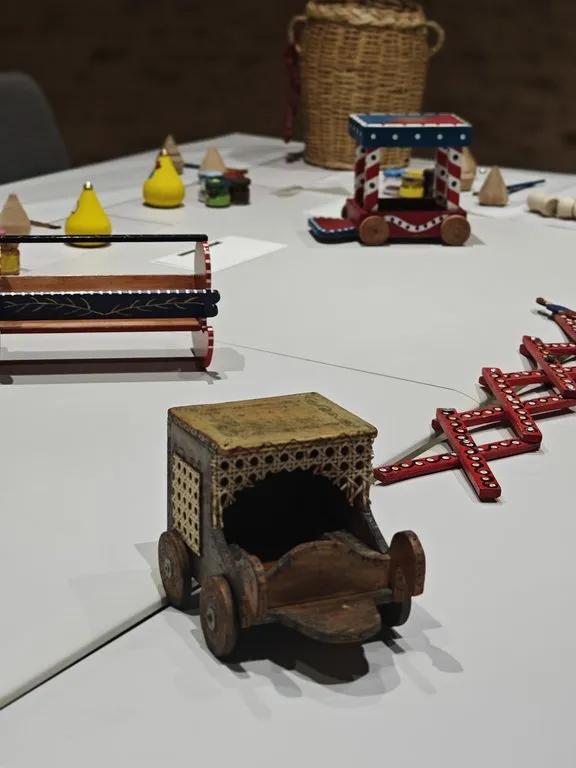
We can trace this tradition into the İBB City Museum’s 28-piece collection too: the inventory lists two clay jugs, sitting in the same case as the wooden carts and drums. Among the first sixteen toy types made in the 2005 revival project is also “an earthenware jug filled with water and made to whistle”: the whistling jug is one of the few types whose continuity runs unbroken from the historical list, through the museum inventory, to today’s production.
The clay carries on
Today our workshop keeps making both the whistling jug and the decorative water jug; both are shaped from the same red clay and go through the same firing process. Another trace of the same earthenware tradition survives in leather: according to Yalçınkaya (p. 294), leather was soaked after being worked and then stretched and bound over toys made of clay or wood, such as tambourines, drums and small hand-drums. In our clay-bodied darbuka today, clay and leather still come together on the same body, just as they did centuries ago. Another craft follows in the footsteps of that same skin-on-body logic today: in our marbling workshop, marbling is applied to the stretched leather skin of a drum, its body still wood. Marbling is a separate craft, but it is one of today’s continuations of the tradition of stretching skin over a body.
Sources
- Geleş, Fadime. “İstanbul Çocuk Oyuncakçıları,” Antik Çağ’dan XXI. Yüzyıla Büyük İstanbul Tarihi, Vol. 4, İSAM + İBB Kültür A.Ş., 2015. https://istanbultarihi.ist/138-istanbul-cocuk-oyuncakcilari
- Yalçınkaya, Tosun (2006). “Eyüp Oyuncakçılığı ve Oyuncak Atölyesi,” Tarihi, Kültürü ve Sanatıyla X. Eyüpsultan Sempozyumu Tebliğleri, Eyüp Belediyesi, p. 290-295.
- Yalçın, Hülya. “Eyüp Oyuncakları Müzesi,” Tarihi, Kültürü ve Sanatıyla Eyüpsultan Sempozyumu VIII: Tebliğler, İstanbul, 2004, p. 69-70.